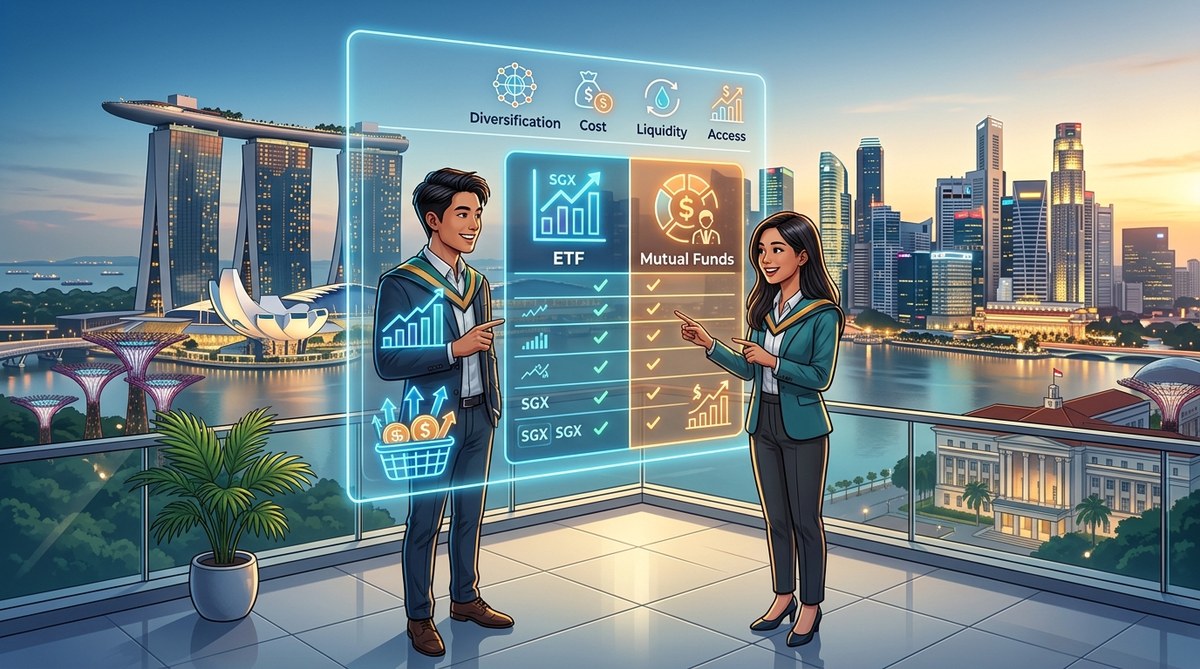
Starting your career in Singapore is exciting and a little overwhelming. You are stepping into a world of opportunities and responsibilities, including how to grow your money wisely. For fresh graduates, the two most common entry points into the investment world are exchange traded funds or ETFs and mutual funds. Both can help you build a diversified portfolio without needing to pick individual stocks. But they work differently and suit different goals. This beginner guide breaks down the essentials in plain language so you can make confident choices that fit your life as a fresh graduate in Singapore.
Understanding the investment landscape for graduates in Singapore
Singapore offers a favorable environment for new investors. There is no capital gains tax on most investments, and the market is highly transparent with a range of options from local to global markets. As a fresh graduate, your time horizon is long because you have decades ahead to compound wealth. That usually means you can take a bit more risk upfront and gradually shift to a balanced mix as your income grows. Here are a few realities to keep in mind as you begin.
- Start small and automate. Consistency beats rare big bets. Small monthly contributions compound over time.
- Diversification matters. ETFs and mutual funds both offer instant diversification that would be hard to achieve by buying a handful of individual stocks.
- Costs add up. Fees eat into returns over the long run, so comparing expense ratios and trading costs is important.
- Taxes and accounts. Singapore residents benefit from certain tax reliefs and can use accounts like a standard cash basket or a Supplementary Retirement Scheme (SRS) to optimize tax efficiency.
What are ETFs and mutual funds
ETFs and mutual funds are both pooled investment products. They collect money from many investors and invest in a diversified portfolio of assets such as stocks, bonds, or a mix of both. The big differences lie in how they are managed, how you buy them, and how costs are charged.
What is an ETF
- An ETF, or exchange traded fund, is a fund that trades on an exchange just like a stock.
- It typically tracks a specific index or sector, aiming to mirror its performance.
- Prices fluctuate during the trading day based on supply and demand.
- Most ETFs are passively managed, meaning they aim to replicate an index rather than trying to beat it.
- Costs are usually lower than many mutual funds, with expense ratios often in the low single digits of a percent. Trading costs can apply when you buy or sell.
What is a mutual fund
- A mutual fund pools money from many investors and is managed by a fund manager.
- It can be actively managed (the manager tries to beat a benchmark) or passively managed (tracks an index).
- Prices are determined once per day at the fund’s net asset value (NAV), not through intraday trading.
- Fees can be higher and may include sales charges, fund management fees, and platform fees.
- Actively managed mutual funds have the potential to outperform a benchmark but require higher fees and higher risk of underperforming.
Quick comparison at a glance
- Trading: ETFs trade intraday; mutual funds are bought and sold at end-of-day NAV.
- Costs: ETFs tend to have lower expense ratios; mutual funds may carry higher fees.
- Tax efficiency: ETFs are generally more tax efficient in practice due to how they are structured, though Singapore tax rules apply differently to different accounts.
- Minimums: Mutual funds may require a minimum initial investment; some ETFs can be bought with a small amount via a broker.
- Accessibility: ETFs are accessible through most stockbrokers; mutual funds are accessible via fund platforms and some banks.
Key differences that matter for fresh grads
- Accessibility of funds: ETFs on SGX can be bought with a standard brokerage account. Mutual funds can be bought through banks or fund platforms and may require more paperwork.
- Cost structure: If you are starting with small monthly contributions, a low-cost ETF could be more cost effective over time. Actively managed mutual funds may eat into returns with higher fees.
- Diversification and control: An ETF that tracks a broad index gives you wide diversification with minimal effort. A mutual fund, especially an actively managed one, offers the potential for alpha but at higher cost and risk.
- Tax implications: While Singapore does not impose capital gains tax on most investments, dividend income and foreign taxes may apply depending on the fund and the structure. Always check how distributions are taxed or relieved for your personal situation.
Which is right for you A fresh grad road map
Choosing between ETFs and mutual funds should come down to your goals, budget, and how much time you want to invest. Here is a simple road map to help you decide.
- If you want simplicity and low ongoing costs, start with a broad market ETF.
- If you want potential active management and are willing to pay higher fees for potential outperformance, research mutual funds with a solid track record and reasonable fees.
- If you are saving for long term goals and prefer hands off investing, a mix of global equity ETFs and a bond ETF or conservative mutual funds can be a good balance.
- If you are comfortable with periodic rebalancing and a bit of learning, you can blend both ETFs and mutual funds to diversify across styles.
Steps to decide
- Clarify your time horizon and risk tolerance.
- Set a monthly investment amount you are comfortable with.
- Choose an account type: cash account for ETFs or mutual funds via a broker; consider SRS if you want tax relief and are planning for retirement.
- Pick your core holdings: one broad market ETF as your foundation, plus a bond or cash allocation.
- Plan to review twice a year and adjust as life changes.
Costs and fees you should understand
One of the biggest advantages of starting early is the ability to benefit from compounding over a long period. The catch is that costs compound too. Here is how to think about costs when you are a fresh graduate.
- Expense ratios: ETFs typically have lower ongoing costs than actively managed mutual funds. Expect a wide range depending on the fund’s strategy and market coverage.
- Trading costs: Buying and selling ETFs can incur brokerage commissions or transaction fees. If you trade infrequently, this matters less; if you auto invest monthly, keep fees in mind.
- Load and sales charges: Some mutual funds may charge sales loads or entry fees, especially if bought through a bank or certain platforms.
- Platform fees: Some platforms add a small ongoing fee, which can eat into returns over many years.
- Dividend reinvestment: Some funds automatically reinvest dividends. This accelerates compounding but check if reinvestment is automatic for the ETF or mutual fund you choose.
Tips to manage costs
– Favor low-cost broad index ETFs for core holdings.
– Avoid frequent trading; set up automatic monthly contributions if possible.
– Compare the total cost of ownership, not just the headline expense ratio.
– Use a single broker where possible to reduce per trade costs.
Tax and regulatory considerations in Singapore
Singapore investment tax rules are investor friendly in many ways, but it is important to understand the basics.
- No capital gains tax in general. Selling an investment for a profit does not trigger capital gains tax under normal circumstances.
- Dividend tax treatment depends on the type of income and the investor. Some dividends may be subject to withholding tax depending on the instrument and residence status of the issuer. Check the fund’s domicile and local tax rules.
- SRS contributions offer tax relief. Contributing to the Supplementary Retirement Scheme can reduce your taxable income, but withdrawals later are taxed at a deferment rate. It is a long horizon planning tool rather than an immediate investment return tool.
- CPF and investments: CPF funds have their own rules about investment accounts and returns. For most fresh grads, investing through CPF requires careful planning and is subject to guidelines set by the CPF board.
Practical takeaway
– For most fresh grads, starting in cash or through a taxable brokerage account with broad market ETFs is a straightforward path. If you have room for tax relief and long term retirement planning, consider SRS to complement your strategy, but understand the withdrawal rules.
Getting started in Singapore
Ready to take the first steps? Here is a practical guide to begin investing in ETFs or mutual funds as a new graduate in Singapore.
Step by step opening an account
- Decide on your structure: cash brokerage account for ETFs and some mutual funds, or an SRS funded account for tax relief and long term goals.
- Choose a broker or platform: many platforms in Singapore offer access to SGX listed ETFs and a wide range of mutual funds. Look for a platform with low fees, good user experience, and solid customer support.
- Fund your account: link your bank account and transfer the amount you plan to invest monthly or as a lump sum.
- Pick core holdings: start with a broad market ETF covering global equities or a Singapore focused fixed income ETF if you want a defensive layer.
- Set up auto contributions and reinvestment: automation helps you stay on track and build discipline.
- Review periodically: twice a year is a good cadence to rebalance and adjust for life changes.
How to buy ETFs and mutual funds in Singapore
- ETFs: Trade on SGX via your broker. You can buy or sell during market hours and the price fluctuates like a stock.
- Mutual funds: Buy through the fund house or your bank or a fund platform. They may have daily NAV pricing and minimum initial investment requirements.
- Dollar cost averaging: With monthly contributions, you buy more shares when prices are low and fewer when prices are high, smoothing out volatility over time.
- Rebalancing: If your allocation drifts due to market movements, rebalance back toward your target mix to maintain risk alignment.
Building a simple starter portfolio
A well designed starter portfolio balances growth potential with risk management. Here are starter templates you can tailor to your personal situation and goals.
Growth focused portfolio (long horizon, higher risk tolerance)
- 70-80% in a broad global equity ETF. This could cover large cap and small cap exposures across markets.
- 20-30% in a Singapore or regional bond ETF or short duration bond fund for some stability.
- Revisit annually to rebalance: if equity allocations drift too far from target, trim a portion and add to bonds.
Balanced portfolio (moderate risk)
- 50-60% global equity ETF
- 30-40% bond ETF or high quality bond mutual funds
- 0-10% cash or money market fund for liquidity needs
Conservative starter portfolio (lower risk, shorter horizon)
- 40-50% global equity ETF
- 40-50% bond ETF or high quality fixed income mutual funds
- 0-10% cash for emergencies
Notes on building the portfolio
– Use broad market or total market ETFs as core holdings to minimize country or sector bets.
– Consider adding a small allocation to a Singapore or regional bond ETF to reduce overall volatility.
– Reinvest dividends to maximize compounding.
– Keep an emergency cash reserve separate from the investment portfolio.
Common pitfalls and how to avoid them
Investing as a fresh graduate is exciting but it also carries common traps. Here are the missteps to dodge and how to stay on track.
- Over trading: Frequent buying and selling can erode returns. Build a plan and stick to it.
- Paying too much in fees: Always compare the total cost of ownership. Low cost options often outperform over the long run.
- Chasing performance: Past returns do not guarantee future results. Focus on low costs, diversification, and a sensible plan.
- No automation: Hidden friction can stop you from investing monthly. Set up automatic contributions.
- Ignoring diversification: Concentrating in a few stocks or sectors heightens risk. Use broad market funds to spread risk.
- Not understanding what you own: Always read the fund factsheets and learn how the ETF or mutual fund is managed.
Tips to stay on track
– Create a simple plan with a target asset allocation and stick to it.
– Use automation for contributions and dividend reinvestment.
– Review your portfolio twice a year and adjust if needed.
– Keep your investing separate from your day to day spending.
Frequently asked questions
- What is easier for a fresh grad ETFs or mutual funds?
- For most beginners, ETFs offer simplicity, transparency and lower costs. They are easier to access via a standard brokerage and trade like stocks.
- Can I start investing with a small amount?
- Yes. Many brokers allow fractional purchases of some ETFs or have low minimums for mutual funds. Start with what you can afford and increase gradually.
- Are mutual funds better than ETFs?
- Not necessarily. It depends on your goals, cost sensitivity and preference for active vs passive management. ETFs are usually cheaper and more tax efficient for long term investors.
- Should I use SRS or just a cash account?
- If you want tax relief and are planning for retirement, consider SRS. It has rules about contributions and withdrawals. If you want simplicity, start with a cash account and grow from there.
- How often should I rebalance my portfolio?
- Twice a year is a good rule of thumb for beginners. You can rebalance to your target allocation if the drift is substantial.
- Do I need to pay taxes on dividends?
- Singapore does not tax capital gains. Dividends can be taxed differently depending on the instrument and your tax residency. Check with your broker or a tax advisor.
Final thoughts
As a fresh graduate, you stand at the threshold of building a habit that can pay off for decades. ETFs and mutual funds offer two accessible paths into investing with broad diversification and manageable risk. ETFs tend to win on cost and tax efficiency and are especially friendly for new investors who want a straightforward, hands free approach. Mutual funds, particularly actively managed ones, offer potential for alpha but require a higher cost and greater attention to the manager’s track record and fees.
The best choice is the one you can stick with over time. Start with a simple core allocation using a broad market ETF and a bond option if appropriate. Automate your contributions, reinvest returns, and review your plan at least twice a year. Remember that your goal as a graduate is not to time the market or chase the hottest fund, but to lay down a steady path toward financial security and future opportunities.
FreshGrads.sg is here to guide Singapore graduates through real estate, investments and smarter living. If you want a quick starter checklist, you can use the following one to keep you organized as you begin your investing journey.
- Define your goal and time horizon.
- Choose a low cost core investment (broad market ETF or a well selected mutual fund).
- Set a monthly contribution and automate it.
- Learn the basics of how your account works and what taxes apply.
- Review and rebalance every six to twelve months.
Starting early is your biggest advantage. With patience, discipline and the right low cost choices, you can build a solid foundation for wealth that can empower you to pursue your dreams, whether that means buying your first home later on, traveling, or funding further education. If you have questions or want to compare specific funds or platforms available in Singapore, feel free to reach out to FreshGrads.sg and join the conversation in our community.