Typing speed used to be a line on a resume that few people paid attention to. In 2026, it quietly shapes hiring decisions across admin, banking, customer service, and even real estate support roles in Singapore. Fresh graduates entering the workforce are expected to handle emails, data entry, CRM systems, chat platforms, and documentation without slowing the team down. That expectation translates into a clear benchmark, words per minute, or WPM.
If you are unsure where you stand, start with a proper typing test. Measuring your current speed gives you data, not guesswork. Employers may not always ask for your exact score, but they quickly notice if you type smoothly or struggle with basic keyboard tasks.
Quick Overview for Fresh Graduates
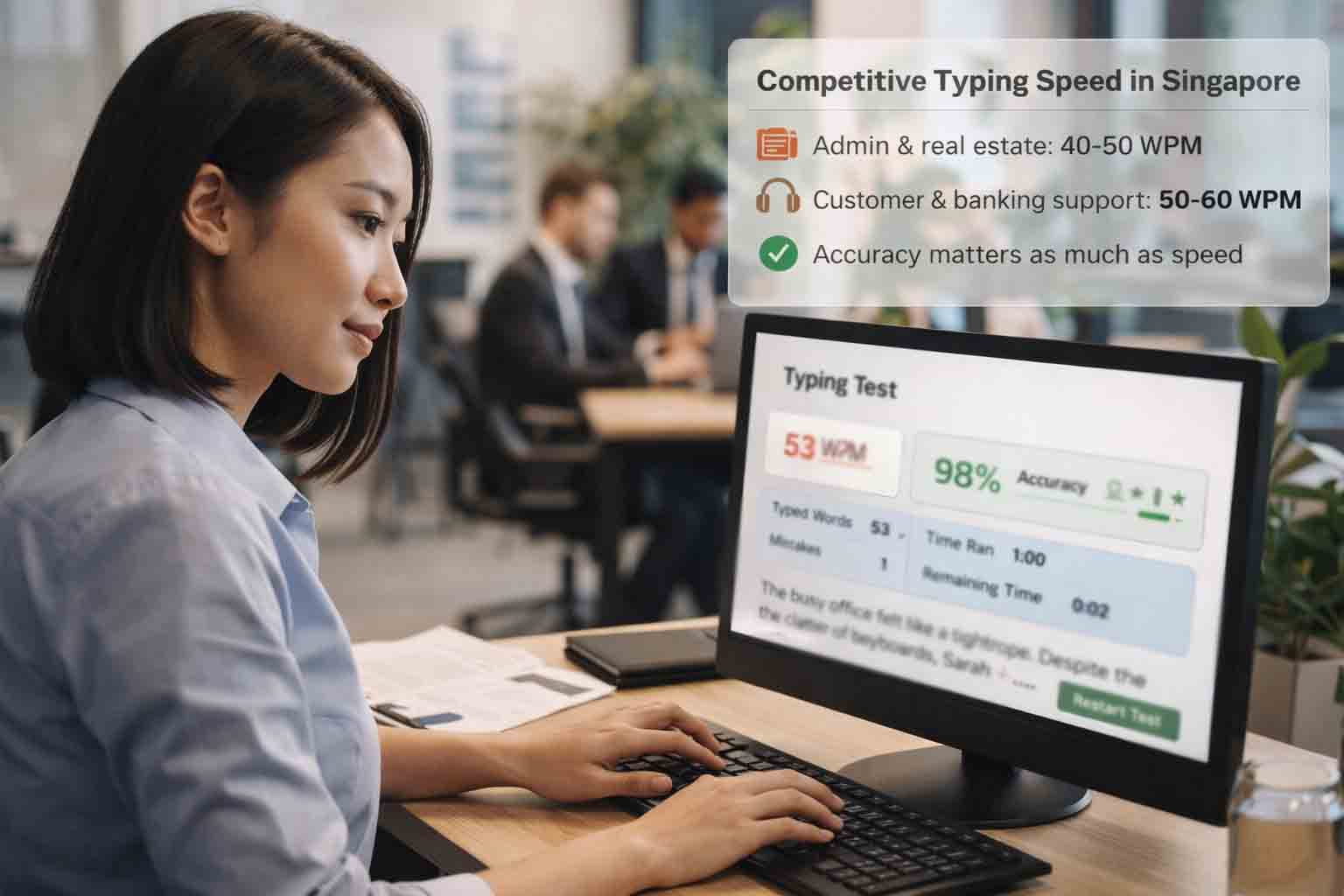
- Most Singapore admin roles expect 40 to 50 WPM.
- Customer service and banking support often prefer 50 to 60 WPM.
- Accuracy matters as much as speed.
- Touch typing reduces stress during busy hours.
- Consistent practice can add 10 WPM within weeks.
What Is Considered a Good Typing Speed in Singapore
In Singapore, the average adult types around 35 to 45 WPM. For fresh graduates, employers usually look for something slightly above average. A safe target is 40 WPM with high accuracy. That means minimal corrections, clean formatting, and confident keyboard use.
For more demanding roles, the range moves higher. Many hiring managers consider 50 to 60 WPM a strong signal that a candidate can handle multitasking under pressure. Among the practical skills to strengthen before applying, typing speed sits comfortably beside communication ability and digital literacy, since all three shape how efficiently you perform in a modern workplace.
Speed alone does not guarantee productivity. Accuracy above 95 percent is often the silent requirement. Employers do not want fast typists who constantly fix mistakes. They want steady output that does not require double checking by supervisors.
Why 40 to 60 WPM Is the Competitive Range
Hiring teams rarely publish typing speed in job ads. Yet internal expectations exist. In entry level admin positions, 40 WPM keeps daily tasks flowing. In banking operations or customer chat support, 50 to 60 WPM helps manage higher volumes.
Here is how the range generally breaks down:
1. Below 35 WPM, you may struggle with heavy documentation tasks.
2. 40 to 45 WPM, suitable for standard admin support.
3. 50 to 60 WPM, competitive for banking and service roles.
4. Above 65 WPM, considered highly efficient for fast paced teams.
Typing faster reduces cognitive load. You spend less mental energy on finding keys and more on processing information. That advantage shows up during interviews when you complete written assessments or live data entry tests.
Industry Specific Expectations for Fresh Graduates
Not every role demands the same typing speed. Context matters. A marketing graduate writing creative copy may not need 65 WPM. A customer service officer responding to live chats likely does.
| Industry | Typical WPM | Why It Matters |
|---|---|---|
| Admin Support | 40 to 50 | Emails, reports, scheduling |
| Real Estate Admin | 45 to 55 | Listings, CRM updates, contracts |
| Banking Operations | 50 to 60 | High volume data entry |
| Customer Service | 50 to 60 | Live chat response time |
Real estate firms in Singapore rely heavily on digital systems. Graduates supporting property teams often handle listing descriptions and internal documentation. That connects closely with topics discussed in property viewing checklist, where attention to detail is vital. Fast and accurate typing helps avoid costly errors in addresses or pricing details.
In banking and financial services, compliance and documentation standards are strict. According to the Monetary Authority of Singapore, financial institutions must maintain accurate records and customer documentation. Typing accuracy supports those regulatory standards. A misplaced digit in an account number can create serious issues.
Speed Versus Accuracy, What Employers Notice First
Recruiters often run short computer based tests during interviews. They observe posture, confidence, and how often you pause. They notice if you keep looking at the keyboard. They notice if corrections slow you down.
Accuracy is usually the first filter. A candidate typing 55 WPM with 88 percent accuracy creates more work for supervisors. A candidate typing 48 WPM with 97 percent accuracy appears reliable. Over time, speed can improve. Consistent accuracy signals discipline.
Touch typing also reduces fatigue. In customer service environments where graduates may respond to hundreds of messages daily, physical comfort affects performance. Smoother typing means fewer wrist and shoulder issues during long shifts.
How to Benchmark Yourself Properly
Benchmarking is simple but must be consistent. Take multiple tests at different times of day. Track both WPM and accuracy. Do not rely on one random result.
- Use a full length one minute test.
- Check accuracy percentage every time.
- Retest weekly to measure progress.
- Focus on improvement trends, not one high score.
Practice sessions of 10 to 15 minutes daily can lead to noticeable improvements within a month. Many fresh graduates preparing for interviews treat typing as part of their routine, similar to refining answers for behavioral questions.
How Typing Speed Impacts Career Growth
At entry level, typing speed supports basic tasks. After a year or two, it affects productivity metrics. Managers often track turnaround times for documentation, email replies, and case updates.
Faster typing can lead to higher output without longer working hours. That efficiency supports performance reviews and promotion discussions. Graduates who handle administrative backlogs quickly are often trusted with more responsibility.
In roles involving client communication, response speed also shapes client perception. Quick, well written replies project competence. Slow replies create doubt. The difference sometimes lies in how fast you can convert thoughts into text.
Common Myths About Typing Speed
Some graduates believe typing speed only matters for secretarial roles. That assumption no longer holds. Almost every corporate job involves heavy digital communication.
Another myth is that young people automatically type fast. Familiarity with smartphones does not guarantee strong keyboard skills. Desktop typing requires different muscle memory and finger placement.
A third myth suggests speed cannot be improved after school. In reality, structured practice can increase speed significantly within weeks. Neural adaptation responds quickly to repetition.
Practical Plan to Reach 50 WPM Before Your First Job
Improvement requires structure. Random practice does little. Focused drills create progress.
1. Learn correct finger placement and avoid looking at the keyboard.
2. Practice common workplace vocabulary such as financial terms and property descriptions.
3. Increase test duration gradually to build stamina.
4. Track weekly averages instead of single attempts.
Graduates preparing for structured hiring timelines often combine typing practice with planning interview schedules. Topics similar to those in graduate timelines and interviews show how preparation reduces stress. Typing fluency is part of that preparation strategy.
Set realistic milestones. Aim for 45 WPM within two weeks. Then push toward 50 WPM. Once you cross 55 WPM with consistent accuracy, you are in a strong position for most entry level roles in Singapore.
Your Keyboard Skills as a Quiet Career Advantage
Typing speed rarely appears in bold on job descriptions. Yet it influences daily efficiency, stress levels, and manager perceptions. In 2026, fresh graduates entering admin, banking, customer service, and real estate support roles benefit from reaching at least 40 to 50 WPM, with 50 to 60 WPM offering a competitive edge.
Strong keyboard skills reflect discipline and digital readiness. They reduce friction in fast paced environments. They signal that you can keep up without constant supervision. For fresh graduates building credibility, that small edge compounds over time.
Investing a few weeks into structured typing practice may not seem exciting. Yet it strengthens one of the most used skills in modern offices. Quiet efficiency often creates the biggest long term returns.